

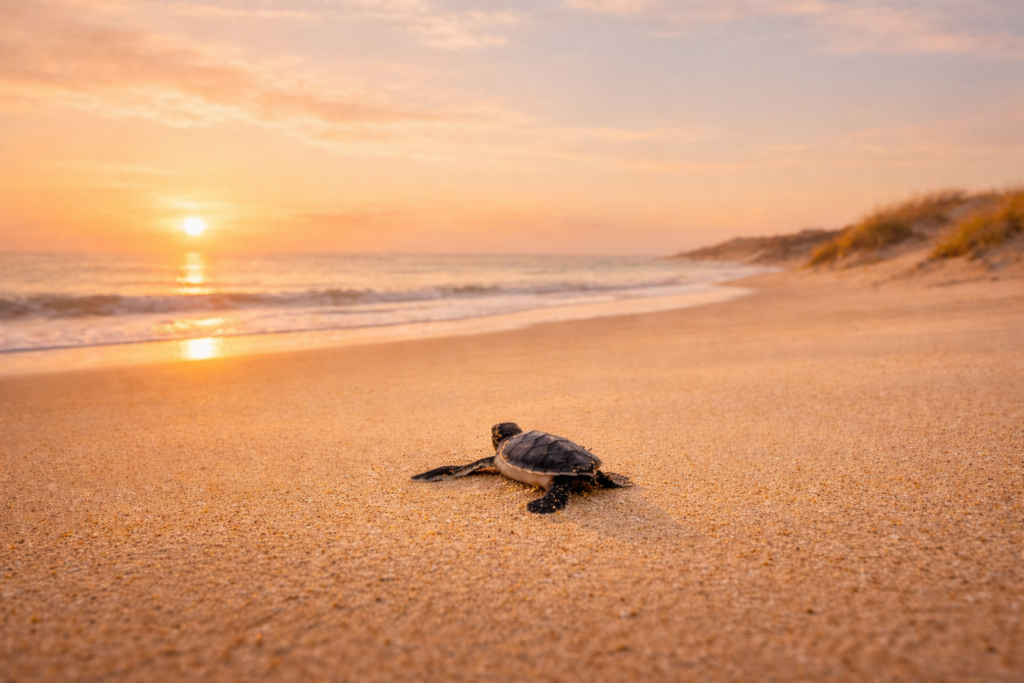
There are places where nature is not just a backdrop, but a rhythm.
The northern coast of Cyprus is included.
Between open stretches of coastline, sandy dunes, and tranquil bays, a cycle repeats itself every year, unchanged for centuries.
A silent, precise interplay of instinct, movement, and time.
These are the paths of sea turtles.
A journey that begins in secret
As temperatures rise and the evenings get longer, a movement begins in the sea that is hardly visible from the outside.
Far out in the water, the animals orient themselves using currents, smells, and an internal compass that leads them back to the exact stretches of coastline where their own life journey once began.
This return is not a random decision.
It is a remembrance.
And it leads back to the beaches of Northern Cyprus every year.
The coasts that leave room
Not every beach is suitable for this return.
The turtles choose places that have remained quiet:
long, open stretches of sand
Dune landscapes
Coastlines without dense development
protected zones with little artificial light
These very characteristics can be found along many stretches between Alagadi, Karpaz and the lesser-known bays of the north coast.
Here the night is still dark enough.
And the landscape is pristine enough.
The track in the sand
Those who visit one of these beaches early in the morning sometimes discover a fine track in the sand.
A pattern of lines leading from the water up to the dunes – and back again.
For many visitors, it’s a fleeting moment.
For nature, it’s part of a centuries-old process.
During the night, an animal entered the beach, dug a hollow, laid its eggs, and retreated.
Everything happens quietly.
Without staging.
Without an audience.
Protection as part of the culture
In recent years, various initiatives have developed in Northern Cyprus that deliberately protect these cycles.
Beach sections are marked.
Nests are documented.
Visitors are informed.
The point is not to exhibit nature, but to respect it.
This attitude also shapes how the locals interact with these places.
You know you’re a guest.
And you behave accordingly.
Another form of encounter
Direct encounters with the turtles rarely occur.
And perhaps that is precisely their strength.
You see no show.
No spectacle.
But a symbol.
A track in the sand.
A marked area in the dunes.
A small indication that life exists here, independent of humans.
For many, this creates a different form of appreciation.
Not through proximity – but through distance.
Nature, which shifts the scale
Anyone who spends time in such landscapes quickly notices that their own perspective changes.
Priorities shift.
Speed becomes less important.
Perception gains depth.
Places like these show that development and nature do not have to be mutually exclusive – as long as there is space.
And this space still exists in Northern Cyprus.
The importance for a location
In traditional location analyses, factors such as infrastructure, prices, or growth play a role.
But there is another, often underestimated aspect:
the quality of the environment.
A region where natural processes can continue to take place, where coastlines are not completely built over, and where ecological cycles are respected, develops a different form of stability.
Not loud.
But sustainable.
A silent sign of continuity
The paths of the sea turtles are not a tourist highlight in the classic sense.
They are a subtle sign.
For the fact that a landscape has retained its original function.
For the continuation of cycles.
And for the fact that not everything has to be accelerated.
Between sea and dunes
When you stand on one of these beaches early in the morning, the sea is calm and the air is still cool, a moment arises that cannot be planned.
A moment when you feel that this place offers space not just for people – but for life as a whole.
And perhaps that is precisely one of the reasons why Northern Cyprus is more than just a destination for many.
It is a place where the present and nature are still in balance.
Between sea and dunes.
Between movement and stillness.
Between a footprint in the sand – and a trail that has returned for generations.