

Some places visibly display their history.
Others keep them quiet.
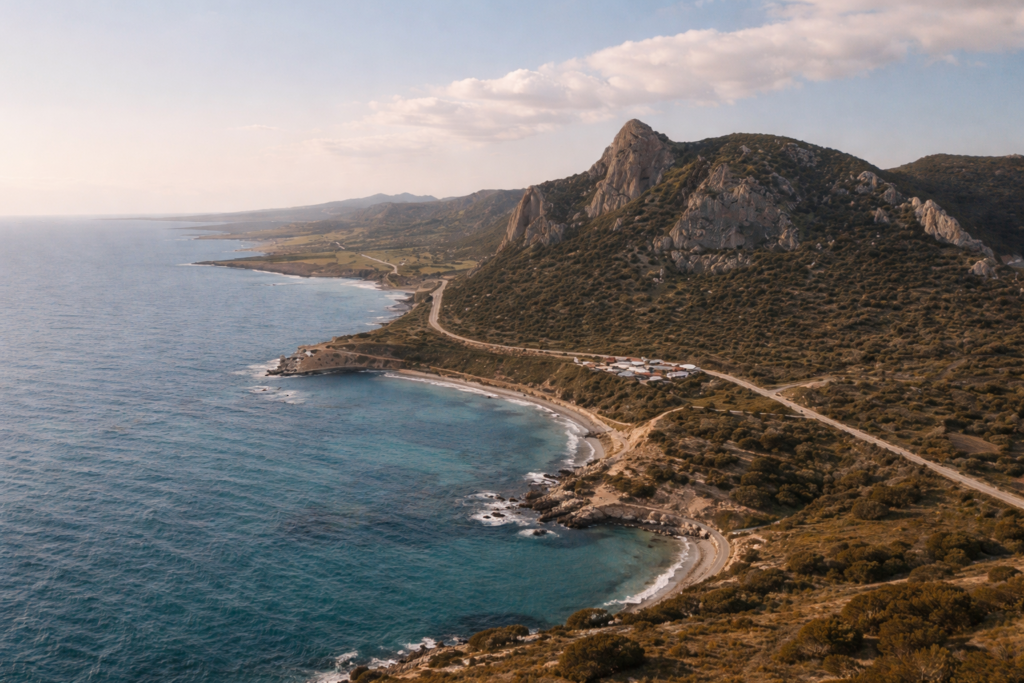
The coastline around Tatlisu belongs to the second category. At first glance, the landscape appears tranquil—rocks, bays, open sea. But as in many parts of the eastern Mediterranean, memories are etched into the landscape here, memories not recorded in chronicles but in stories passed down from generation to generation.
One of these stories is about a young girl.
An escape that became part of the landscape
Centuries ago, when pirates operated along the Mediterranean coast, the northern coast of Cyprus was no exception. Small settlements, secluded bays, and open coastlines offered little defense against raids.
According to legend, a group of pirates appeared one day in the region around Tatlisu. Houses were searched, supplies plundered, and people were hunted.
A young girl is said to have fled at that moment.
Not inland, but up into the rocky hills above the coast—to where small caves and crevices open in the rock. There, so the elders say, she hid above the sea.
Some versions report that she remained there for days until the danger had passed and she could return.
Others tell the story differently.
More quietly.
More tragically.
That she stayed.
That she never returned.
And that her presence has since become part of the landscape.
Between History and Memory
Like many orally transmitted stories, this one also has several versions. There is no fixed location, no marked point, no official name. And that is precisely part of its power.
The coast remains anonymous — and precisely for that reason open to imagination.
Historically, the background is plausible. Between the 15th and 18th centuries, the northern coast of Cyprus was repeatedly targeted by pirate raids. Particularly remote regions, such as those around Tatlisu, offered little protection and were therefore frequently affected.
Similar narratives can be found all along the coastline. Stories of escape, of hiding, of families retreating to caves while ships lay on the horizon.
The legend of the girl from Tatlisu is representative of this period.
The role of the landscape
What makes this story special is its connection to the surroundings.
The hills, the rocks, the small crevices in the stone—they are still visible today. Anyone walking along the coast can see how easily someone could have hidden here. The landscape doesn’t appear staged, but rather functional.
It is not just a backdrop, but part of the plot.
Perhaps that’s why the story has remained. Not because it has been proven, but because it fits credibly into the surroundings.
Why do such stories persist?
Places with a long history carry not only official past but also collective memory.
These memories serve a purpose. They explain what people felt, how they dealt with danger, and how closely their lives were intertwined with the landscape. They show that coastlines were not always places of tranquility, but also places of risk, courage, and decision-making.
At the same time, they tell us something about continuity.
That people have stayed.
That places have changed, but haven’t lost their identity.
Tatlisu today
Anyone traveling along the Tatlisu coast today will experience a different rhythm.
Quiet bays, clear vistas, low population density. The region is one of the places on the island where development and unspoiled nature are still in balance.
There are projects, infrastructure, international movement — but at the same time also space, silence and a landscape that has preserved its structure.
Perhaps it is precisely this balance that many visitors perceive, even if they do not know the history.
A feeling that a place is more than its presence.
The significance for today
Such stories are not a tourist detail.
They are part of what makes a place unique. They add depth without being loud. They create a connection between past and present that is not based on numbers, but on perception.
For people who view places not just functionally, but holistically, this creates a different kind of value.
A place is not judged solely by its infrastructure, but by its atmosphere. By its history. By the feeling that something has grown here.
A silent presence
Whether the girl from Tatlisu actually existed cannot be proven.
But the story remains.
Perhaps because it touches on something fundamental:
the relationship between people and places, between danger and protection, between past and present.
And perhaps also because it reminds us that some places hold more than meets the eye.
The coast is calm.
The sea moves steadily.
The rocks have stood for centuries.
And somewhere in this landscape, a story has remained — quiet, invisible, but palpable.