

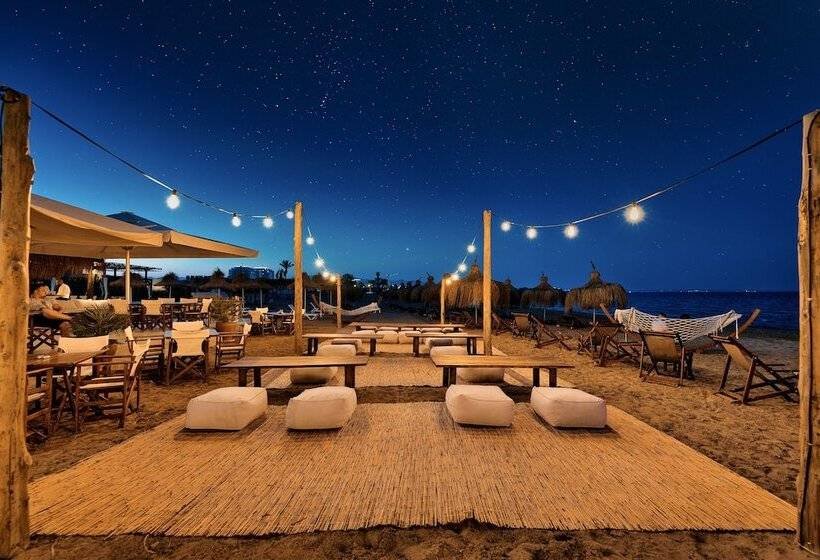
Longevity as a new form of location quality
The question of how long a person lives is usually understood as a medical issue.
However, international research has shown a different picture for years:
The decisive factors do not arise in clinics, but in everyday life.
Where we live, how we move around, what we eat, and how we interact with other people shape our lifespan more than individual medical interventions. In this context, so-called Blue Zones have become established worldwide as a benchmark—regions where people statistically live longer and healthier lives than the global average.
These places do not differ in any single characteristic.
They follow a common principle: The environment automatically supports healthy behavior.
Longevity is created by structure, not by discipline.
In many urban systems, health needs to be actively organized:
Movement is being planned
Nutrition is controlled
Social contacts are being scheduled.
Stress must be actively compensated for.
In Blue Zone-like regions, the opposite is true.
Health-promoting factors are not an add-on there , but an integral part of everyday life .
Movement arises from the routes taken.
Nutrition comes from local availability.
Social contact is fostered through proximity.
Rhythm is dictated by climate and daylight.
The environment takes on some of the responsibility that has been shifted to the individual in modern cities.
The five key influencing factors
Studies of long-lived regions consistently show a similar pattern of five structural elements:
1. Natural light and climate
Regular sun exposure affects sleep, hormone balance, and energy levels. A stable daily rhythm reduces stress responses in the body.
2. Low-threshold exercise
Not intensive exertion, but continuous activity in everyday life: walking, carrying, stairs, outdoor exercise.
3. Simple, unprocessed food
Fresh ingredients, regional products, healthy fats, minimal industrial processing.
4. Social integration
Regular, unplanned encounters in everyday life — not just organized appointments.
5. Low structural stress
Less constant sensory overload, less time pressure, less fragmented attention.
These factors don’t seem spectacular.
But they are at work every day — and that’s precisely where their strength lies.
The underestimated factor: location
When these elements come together, an environment is created that does not force health, but enables it.
This is precisely where location choice becomes a strategic factor.
A place influences:
how much you move
how to sleep
how to eat
how often you exchange information
how high the stress level is in everyday life
This directly influences long-term performance.
This connection is particularly relevant for entrepreneurs, investors, and internationally active decision-makers. Their performance is not just a personal matter, but an integral part of their professional system.
Northern Cyprus in the context of modern longevity discussions
Applying these findings to real-world locations makes it clear why certain regions are becoming increasingly important.
Northern Cyprus combines a number of the structural prerequisites that are regularly mentioned in longevity research:
a mild, sunny Mediterranean climate for much of the year
short distances that make everyday movement easier
immediate proximity to the sea and nature
Access to fresh, regional food
a culture in which social encounters are taken for granted
at the same time a growing international community
This combination is not an artificially created concept, but a naturally evolved structure.
This means that health-promoting routines don’t need to be planned — they just happen.
From destination to habitat
A crucial difference lies in how a place is used.
Destinations are visited.
Habitats are integrated.
In regions that meet longevity criteria, stays become longer. Visitors don’t just come once, but regularly. Routines develop. Contacts are established. The place becomes part of one’s annual rhythm.
Northern Cyprus is currently in exactly this phase.
The region is evolving from a classic tourist destination into a complementary location for international lifestyles . Entrepreneurs, remote workers, and investors are using the location not just temporarily, but functionally—as a second environment for living and working.
Longevity as an economic factor
This development also has an economic dimension.
When people stay in one place for a longer period of time, demand changes:
Infrastructure becomes more stable
Services are differentiating themselves
Networks are formed
Investments are becoming more long-term
Capital follows these movements.
A location that combines health, quality of life and functional accommodation models generates a different form of demand than purely tourism markets.
It becomes a system.
Lifespan as a new measure of value
In a time when many economic processes have become digitized and location-independent, the weighting of location factors is shifting.
Productivity no longer arises solely from speed,
but from clarity, energy, and concentration.
Health, mental stability, and long-term performance thus become economically relevant factors.
A location that supports these factors becomes not just a pleasant place — but a strategic asset.
Conclusion
Longevity is not a lifestyle trend.
It is a structural consideration of quality of life.
Places that offer health-promoting conditions are gaining in importance in a globally networked world. Not as a short-term trend, but as a long-term foundation for lifestyles and work models.
Northern Cyprus fulfills many of the criteria mentioned in international longevity discussions. Not as a staged concept, but as an established reality.
For people who assess locations not only according to economic indicators, but also according to their impact on life expectancy and quality of life, this creates a new perspective:
A place can be more than a market.
It can be a framework for a longer, healthier, and clearer life.
And that is precisely where its greatest long-term value lies.