

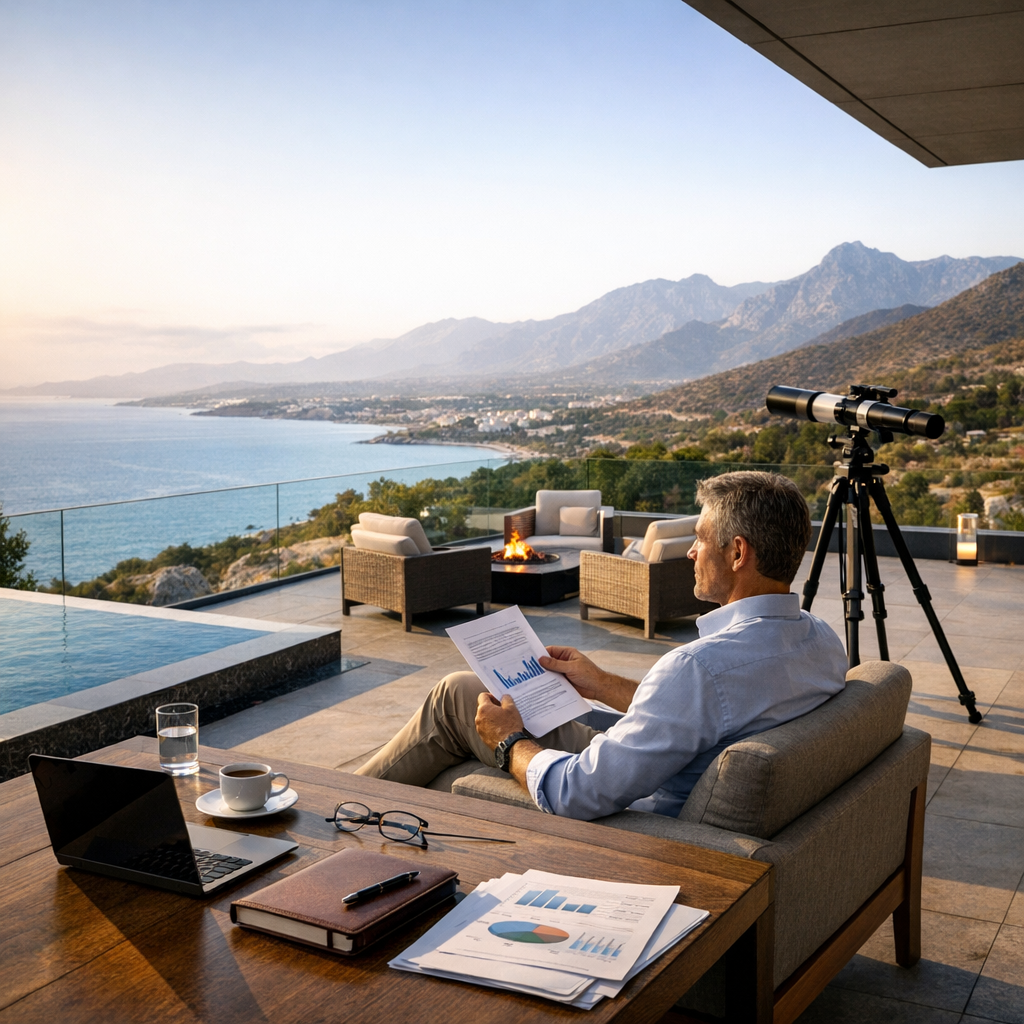
For many entrepreneurs and internationally active decision-makers, a residence has long since become more than just a private address. It is becoming a strategic factor—similar to an additional market, a new business location, or a diversified asset portfolio.
This development is not happening for lifestyle reasons alone.
It arises from the realization that the environment has a direct influence on decisions. Those who work under sustained high levels of responsibility need locations with different functions: dynamic centers for operational matters — and quieter locations for planning, reflection, and regeneration.
A second residence fulfills precisely this role.
It doesn’t primarily serve as a retreat in the traditional sense, but rather as a complement to one’s existing life. It’s a place where conversations can be more focused, where time slots are larger, and where strategic topics can be addressed without constant interruption.
Many entrepreneurs report that the quality of their decisions noticeably improves once they gain some distance from day-to-day operations. New ideas emerge more easily, priorities become clearer, and long-term perspectives come to the fore. The location acts as an external framework that facilitates focus.
In addition to this personal aspect, structural considerations also play a role.
An additional residence can help to distribute stays internationally, make business trips more efficient, or observe new markets from a more stable position. For globally active individuals, this creates a flexible base that is not tied to a single location.
Interestingly, such decisions are rarely made in the short term. The process usually begins with repeated visits, on-site discussions, and building a small network. Only when trust is established in the infrastructure, the environment, and long-term development is a location shortlisted.
This is precisely where the difference between a holiday property and a strategic second home becomes apparent.
While a holiday resort primarily offers relaxation, a strategic location combines several functions: quality of life, accessibility, stability, and an environment that fosters productive conversations. Real estate is thus viewed not merely as property, but as a platform for activities—both business and personal.
In emerging regions, this effect can be particularly pronounced. Markets with room for growth offer not only potential but also time to build structures at a relaxed pace. Contacts develop organically, routines evolve, and the location is gradually integrated into one’s personal life and work rhythm.
In this context, Northern Cyprus is increasingly perceived as such a supplementary location.
The combination of a Mediterranean climate, manageable distances, a growing international presence, and a palpable sense of calm creates conditions that differ from those of densely populated metropolises. Here, conversations often take place outside of traditional business settings—on terraces, during shared activities, or during short breaks between projects.
For entrepreneurs with multiple areas of responsibility, this creates a practical advantage: a place that allows for both relaxation and productive time slots without being completely cut off from global events.
In the long term, a second residence is therefore less about status than about structure.
He creates options.
He distributes presence.
He enables changes in perspective.
In an increasingly interconnected economy, this very flexibility becomes a strategic asset. Locations fulfill different functions, and the ability to switch between them not only increases quality of life but often also the quality of decision-making.
That’s why many experienced entrepreneurs plan their residences similarly to their portfolio: diversified, functional, and with a multi-year perspective. Not every location has to do everything—but each should fulfill a clear role.
A strategic second home is therefore not a luxury in the classical sense.
It is a tool.
A place that creates space — for focus, for conversations and for decisions that don’t have to be made under time pressure.